

Copper
8.96
63.546
[Ar] 3d104s1
63Cu
11
4
d
29
2, 8, 18, 1
745.482
Cu
8.96
1084.62°C, 1984.32°F, 1357.77 K
2560°C, 4640°F, 2833 K
Prehistoric
7440-50-8
22414
More Information
Uses and Properties
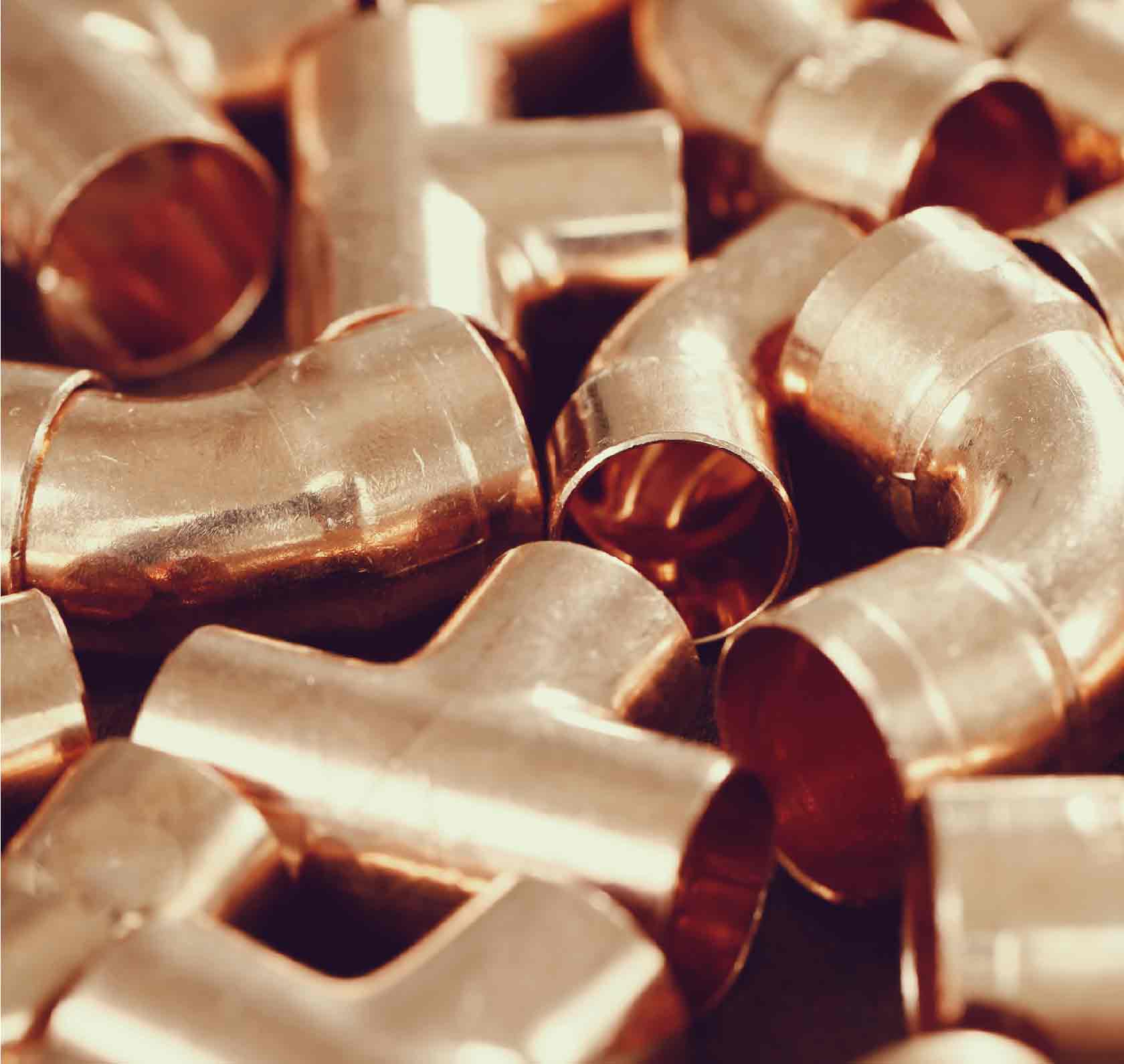
Image Explanation
In the realm of plumbing, copper pipes are favored for their durability, corrosion resistance, and exceptional thermal conductivity.
Appearance
A reddish-gold metal that is easily worked and drawn into wires.
Uses
Copper, symbolized by Cu with its atomic number 29, is an exceptional metal that has played a pivotal role in human civilization for thousands of years. With its remarkable combination of properties, including excellent electrical and thermal conductivity, malleability, and corrosion resistance, copper has found applications across a wide spectrum of industries. In this article, we will explore the diverse and enduring uses of copper, showcasing its significance in shaping our modern world.
Copper's superb electrical conductivity makes it an essential material in the electrical and electronics industry. The metal's low electrical resistance allows for efficient transmission of electricity with minimal energy loss. As a result, copper is the primary choice for electrical wiring and cable production, ensuring that electricity is delivered safely and reliably to homes, businesses, and industries.
Copper is also integral to the production of printed circuit boards (PCBs) used in electronic devices like computers, smartphones, and televisions. Its excellent heat dissipation properties make it ideal for carrying high-frequency signals and maintaining the stability of electronic components.
Copper has been a staple in plumbing and piping systems for generations. Its corrosion resistance and durability make it an excellent choice for transporting water and gases. Copper pipes are commonly used in residential, commercial, and industrial plumbing systems, ensuring a safe and hygienic water supply.
The versatility of copper extends to HVAC (Heating, Ventilation, and Air Conditioning) systems, where it is used in heat exchangers and air conditioning coils. Copper's heat transfer efficiency contributes to the effectiveness of these systems, maintaining indoor comfort levels.
Copper's aesthetic appeal and longevity have made it a popular choice in architectural and construction applications. The distinctive green patina that develops over time gives copper roofing, cladding, and architectural detailing a unique character. Copper's ability to withstand harsh weather conditions, such as rain and extreme temperatures, ensures the longevity of building components.
Copper is also used for gutters, downspouts, and flashings in construction, efficiently directing rainwater away from structures. Its antimicrobial properties further contribute to its suitability in applications where hygiene is paramount.
Copper plays a significant role in the transportation sector, particularly in the automotive and aerospace industries. In automobiles, copper is used in electrical wiring, connectors, and various components, contributing to the functionality of modern vehicles. Copper alloys are also employed in the production of radiator cores, brake lines, and bearings, ensuring safe and reliable transportation.
In the aerospace industry, copper is an essential material for manufacturing aircraft components, including hydraulic systems, landing gear, and avionics. Its lightweight properties and resistance to corrosion make it valuable for the demanding conditions of air travel.
Copper is an integral part of the renewable energy revolution. In solar energy systems, copper is used in photovoltaic cells to conduct and convert sunlight into electricity. The efficiency of these cells is closely linked to the purity and conductivity of the copper used.
Furthermore, copper plays a crucial role in wind energy generation. It is used in generators, transformers, and power cables in wind turbines, ensuring the efficient conversion and transmission of wind energy to the grid.
Copper's antimicrobial properties have been harnessed in healthcare settings to reduce the risk of infections. Copper and its alloys are used in the production of antimicrobial touch surfaces, such as door handles, handrails, and bedrails in hospitals and healthcare facilities.
Copper's biocompatibility and resistance to corrosion make it suitable for medical devices and implants. From orthopedic implants like hip and knee replacements to dental tools and diagnostic equipment, copper's versatility contributes to the advancement of medical technology.
Copper, along with its alloys, has a long history in the minting of coins and currency. Copper coins are valued for their durability and resistance to wear, ensuring that they remain in circulation for extended periods. In the United States, the one-cent coin, commonly known as the "penny," has been made of copper-plated zinc since 1982.
Copper's warm and lustrous appearance has made it a preferred choice for artistic and decorative applications. From sculptures and artwork to cookware and utensils, copper adds an aesthetic and functional dimension to various aspects of daily life.
In addition to its visual appeal, copper cookware's excellent heat conductivity ensures precise and uniform cooking, making it a favorite among chefs and cooking enthusiasts.
Copper's remarkable combination of properties, including conductivity, corrosion resistance, and versatility, has established it as an indispensable material in our modern world. From the wires that power our homes to the pipes that carry water, from the coins in our pockets to the technology we use daily, copper's enduring legacy is evident in various aspects of our lives.
As we continue to advance technologically and environmentally, copper remains a key player in achieving sustainable and efficient solutions. Its ability to adapt and excel in diverse applications demonstrates its timeless brilliance. Copper's history is a testament to its enduring importance, and its future promises to be just as bright, as we explore new and innovative ways to harness its unique properties for the betterment of society and the planet.
The Timeless Brilliance of Copper: Unveiling its Diverse Range of Applications
Copper, symbolized by Cu with its atomic number 29, is an exceptional metal that has played a pivotal role in human civilization for thousands of years. With its remarkable combination of properties, including excellent electrical and thermal conductivity, malleability, and corrosion resistance, copper has found applications across a wide spectrum of industries. In this article, we will explore the diverse and enduring uses of copper, showcasing its significance in shaping our modern world.
Electrical and Electronics
Copper's superb electrical conductivity makes it an essential material in the electrical and electronics industry. The metal's low electrical resistance allows for efficient transmission of electricity with minimal energy loss. As a result, copper is the primary choice for electrical wiring and cable production, ensuring that electricity is delivered safely and reliably to homes, businesses, and industries.
Copper is also integral to the production of printed circuit boards (PCBs) used in electronic devices like computers, smartphones, and televisions. Its excellent heat dissipation properties make it ideal for carrying high-frequency signals and maintaining the stability of electronic components.
Plumbing and Piping
Copper has been a staple in plumbing and piping systems for generations. Its corrosion resistance and durability make it an excellent choice for transporting water and gases. Copper pipes are commonly used in residential, commercial, and industrial plumbing systems, ensuring a safe and hygienic water supply.
The versatility of copper extends to HVAC (Heating, Ventilation, and Air Conditioning) systems, where it is used in heat exchangers and air conditioning coils. Copper's heat transfer efficiency contributes to the effectiveness of these systems, maintaining indoor comfort levels.
Architecture and Construction
Copper's aesthetic appeal and longevity have made it a popular choice in architectural and construction applications. The distinctive green patina that develops over time gives copper roofing, cladding, and architectural detailing a unique character. Copper's ability to withstand harsh weather conditions, such as rain and extreme temperatures, ensures the longevity of building components.
Copper is also used for gutters, downspouts, and flashings in construction, efficiently directing rainwater away from structures. Its antimicrobial properties further contribute to its suitability in applications where hygiene is paramount.
Transportation
Copper plays a significant role in the transportation sector, particularly in the automotive and aerospace industries. In automobiles, copper is used in electrical wiring, connectors, and various components, contributing to the functionality of modern vehicles. Copper alloys are also employed in the production of radiator cores, brake lines, and bearings, ensuring safe and reliable transportation.
In the aerospace industry, copper is an essential material for manufacturing aircraft components, including hydraulic systems, landing gear, and avionics. Its lightweight properties and resistance to corrosion make it valuable for the demanding conditions of air travel.
Renewable Energy
Copper is an integral part of the renewable energy revolution. In solar energy systems, copper is used in photovoltaic cells to conduct and convert sunlight into electricity. The efficiency of these cells is closely linked to the purity and conductivity of the copper used.
Furthermore, copper plays a crucial role in wind energy generation. It is used in generators, transformers, and power cables in wind turbines, ensuring the efficient conversion and transmission of wind energy to the grid.
Healthcare and Medical Devices
Copper's antimicrobial properties have been harnessed in healthcare settings to reduce the risk of infections. Copper and its alloys are used in the production of antimicrobial touch surfaces, such as door handles, handrails, and bedrails in hospitals and healthcare facilities.
Copper's biocompatibility and resistance to corrosion make it suitable for medical devices and implants. From orthopedic implants like hip and knee replacements to dental tools and diagnostic equipment, copper's versatility contributes to the advancement of medical technology.
Coins and Currency
Copper, along with its alloys, has a long history in the minting of coins and currency. Copper coins are valued for their durability and resistance to wear, ensuring that they remain in circulation for extended periods. In the United States, the one-cent coin, commonly known as the "penny," has been made of copper-plated zinc since 1982.
Art and Decor
Copper's warm and lustrous appearance has made it a preferred choice for artistic and decorative applications. From sculptures and artwork to cookware and utensils, copper adds an aesthetic and functional dimension to various aspects of daily life.
In addition to its visual appeal, copper cookware's excellent heat conductivity ensures precise and uniform cooking, making it a favorite among chefs and cooking enthusiasts.
Conclusion
Copper's remarkable combination of properties, including conductivity, corrosion resistance, and versatility, has established it as an indispensable material in our modern world. From the wires that power our homes to the pipes that carry water, from the coins in our pockets to the technology we use daily, copper's enduring legacy is evident in various aspects of our lives.
As we continue to advance technologically and environmentally, copper remains a key player in achieving sustainable and efficient solutions. Its ability to adapt and excel in diverse applications demonstrates its timeless brilliance. Copper's history is a testament to its enduring importance, and its future promises to be just as bright, as we explore new and innovative ways to harness its unique properties for the betterment of society and the planet.
History
Copper, symbolized by Cu with its atomic number 29, is a remarkable metal with a rich and storied history that spans millennia. From its discovery and use by ancient civilizations to its essential role in modern industry and technology, Copper's versatility and unique properties have made it one of the most enduring and indispensable materials in human history. In this article, we will take a journey through time to explore the fascinating history of Copper and the profound impact it has had on our world.
The Ancient Roots of Copper
Copper's history can be traced back over 10,000 years when early humans first began to recognize its value. The discovery of native Copper, pure and readily available in nature, marked a significant milestone in the development of human civilization. Early humans learned to shape Copper into tools, weapons, and decorative objects, marking the transition from the Stone Age to the Copper Age.
The earliest known use of Copper dates to around 9000 BC in the Middle East, where it was used for crafting tools and ornaments. As societies advanced, so did their understanding of Copper's malleability and corrosion resistance, leading to more sophisticated applications.
Copper in Ancient Civilizations
Copper played a pivotal role in many ancient civilizations, shaping their cultures, economies, and technological advancements. One of the most well-known ancient uses of Copper was in the creation of coins. The first Copper coins are believed to have been produced by the Sumerians around 3000 BC, marking a significant advancement in commerce and trade.
The Egyptians utilized Copper for a wide range of applications, including jewelry, cookware, and the construction of monumental structures such as the pyramids. The Copper mines of Timna in modern-day Israel, dating back to the ancient Egyptians, serve as a testament to the value placed on this metal in antiquity.
The Indus Valley Civilization, one of the world's oldest urban cultures, had a deep appreciation for Copper. They used Copper for both practical and ornamental purposes, evident in their art and artifacts that have been unearthed by archaeologists.
In ancient Greece, Copper was an essential component in the development of various technologies. The Greeks recognized Copper's alloying potential and created a durable alloy called bronze by mixing Copper with tin. This innovation revolutionized weaponry and warfare, leading to the iconic era of the Bronze Age.
Copper in the Roman Empire
The Roman Empire is renowned for its widespread use of Copper in construction and plumbing. Aqueducts, bridges, and buildings were often adorned with Copper ornaments, while the famous Roman baths featured complex plumbing systems with Copper pipes.
The Romans also recognized Copper's antifouling properties in marine environments. They sheathed the hulls of their ships with Copper plates to prevent the growth of marine organisms, a practice that anticipated modern anti-fouling technologies.
Copper in the Middle Ages
The importance of Copper continued into the Middle Ages. Copper was a vital element in the development of ecclesiastical art, with Copper being used to create intricate engravings, statues, and ornate church doors.
Copper also found its place in the brewing industry. The antimicrobial properties of Copper were leveraged for beer production. Copper kettles and brewing vessels helped maintain the purity of beer, a practice that continues in some traditional breweries today.
The Birth of the Modern Copper Industry
The Industrial Revolution marked a significant turning point in the history of Copper. With the advent of steam power and advanced machinery, Copper mining and processing became more efficient and widespread.
Copper's electrical conductivity was discovered and harnessed during this period, leading to its use in telegraph cables, electrical wiring, and early electrical devices. The development of the telegraph and telephone systems would not have been possible without Copper's excellent conductivity.
The Modern Era of Copper
In the 20th century, Copper's importance skyrocketed with the emergence of the electrical and electronics industries. Copper became a cornerstone of electrical power generation and distribution systems. It is used in transformers, generators, motors, and electrical wiring, ensuring the efficient flow of electricity worldwide.
The 21st century has seen a further expansion of Copper's role in modern technology. The rise of renewable energy sources, such as wind and solar power, relies on Copper's conductivity for efficient energy transmission. Copper is used in photovoltaic cells and wind turbine generators, contributing to the global shift towards sustainable energy.
Copper in Medicine
Copper's antimicrobial properties have found applications in the medical field. Copper surfaces and alloys are utilized in healthcare facilities to reduce the risk of infections. Research is ongoing to explore the use of Copper nanoparticles in medical equipment and as a potential treatment for certain ailments.
Copper Today
Today, Copper's importance remains as strong as ever. It is an essential component in our daily lives, from the electrical wires that power our homes to the plumbing systems that deliver clean water and remove wastewater. It is a vital element in the construction of green buildings and infrastructure that promote sustainability.
Furthermore, Copper's recyclability adds to its allure as an eco-friendly material. Recycling Copper reduces the need for mining, conserving natural resources and minimizing environmental impact.
The history of Copper is a testament to the enduring value of this remarkable metal. From its early use in ancient civilizations to its central role in the modern world, Copper has continuously proven its worth in countless applications. Its properties of conductivity, malleability, and antimicrobial effectiveness continue to make it an indispensable material in the 21st century.
As we embrace technological advances, sustainability, and innovation, Copper's legacy remains brilliantly intact, serving as a timeless and reliable foundation for progress and development in our ever-evolving world.
Atomic Data
Atomic Radiues, Non-bonded (A): 1.96
Electron Affinity (kJ mol-1): 119.159
Covalent Radiues (A): 1.22
Electronegativity (Pauling Scale): 1.90
| Ionisation Energies (kJ mol-1) | 1st | 2nd | 3rd | 4th | 5th | 6th | 7th | 8th |
|---|---|---|---|---|---|---|---|---|
| 745.482 | 1957.919 | 3554.616 | 5536.33 | 7699.5 | 9938 | 13411 | 16017 |
Oxidation States and Isotopes
Common oxidation states 2, 1
| Isotope | Atomic Mass | Natural Abundance | Half Life | Mode of Decay |
|---|---|---|---|---|
| 63Cu | 62.930 | 69.15 | - | - |
| 65Cu | 64.928 | 30.85 | - | - |
Supply Risk
Relative Supply Risk: 4.3
Crustal Abundance (ppm): 27
Recycle Rate (%): >30
Production Conc.(%) : 34
Top 3 Producers:
1) Chile
2) Peru
3) China
1) Chile
2) Peru
3) China
Top 3 Reserve Holders:
1) Chile
2) Peru
3) Australia
1) Chile
2) Peru
3) Australia
Substitutability: Low
Political Stability of Top Producer: 67.5
Political Stability of Top Reserve Holder: 67.5
Pressure and Temperature Data
Specific Heat Capacity: 385
Shear Modulus: 48.3
Young Modulus: 129.8
Bulk Modulus: 137.8
| Pressure 400k | Pressure 600k | Pressure 800k | Pressure 1000k | Pressure 1200k | Pressure 1400k | Pressure 1600k | Pressure 1800k | Pressure 2000k | Pressure 2200k | Pressure 2400k |
|---|---|---|---|---|---|---|---|---|---|---|
| - | - | 6.60 x 10⁻¹¹ | 1.53 x 10⁻⁶ | 0.00122 | 0.135 | 3.94 | 54.4 | - | - | 137.8 |
Podcast
Transcript :
From its early days, Copper has been essential to human development. It played a significant role in technology, culture and in numerous metabolic processes and overdose of copper can impair the function of genes. It is why this element is so important to maintain a healthy balance of copper in the body. A number of medical researchers have recommended its use for treatments of a variety of diseases. This metal belongs to the group of elements known as non-ferrous. In addition to that, Copper is a very adaptable material and many people consider it to be precious. As such, it has been a central part of human civilization in recent times. For instance, during the time of the Aztec civilization, copper was used for medical purposes. This included gargles for sore throats, and treatment for burns and ulcers.
The earliest traces of copper were found in Mesopotamia around 4500 before the current era. The history of copper can be traced back to early human civilizations, and is found throughout the world. The first copper artifacts were created by natives, who utilized simple copper oxide ores.
After the discovery of the extraction process, metallurgy was born. Several societies organized copper production at different stages of history.
The ancient Egyptians also discovered the potential of the metal. It is formed by volcanic activity in sulfurous regions. These regions are known as copper ores. The Egyptians discovered that copper could be combined with tin and arsenic to produce bronze. Eventually, bronze spread to many parts of the world. Ancient Egypt, India, China, Greece, and Persia all crafted copper.
Mesopotamia, Iran, and South America developed copper metallurgy around the time of the Bronze Age. In the late 18th century, discoveries by Ampere and Ohm, led to a new era of copper.
On the biosphere, copper has the position of being the 2nd most expensive metal. Copper is a spontaneously occurring metal that may be found mostly in igneous and sedimentary rocks as well as in minerals. The main ore is called chalcopyrite. In nature, copper is found in malachite and cuprite. The deposits are found in Australia, Chile, and Indonesia. There are a number of different types of copper ores. The most common type of ore is chalcopyrite, which produces a concentration of about 20 to 30% copper. The other type is bornite, which is a very large rock.
Another type is cupric oxide, which is an oxidizing agent. This element is black powder that can be dissolved in alkali cyanides or acids. In the early 1800s, entire cities were dedicated to mining copper. Twenty-four companies were formed to mine mass copper deposits. Most of the world's copper was produced at these sites. One of the most interesting aspects of the American West is its surprisingly rich deposits of copper. As a result, mining costs have plummeted to about 35 dollars per ton of rock. And the state of Arkansas is a particularly enticing place to find ore bodies.
Copper has several beneficial characteristics, including high tensile strength and excellent conductivity. This element is a reddish metal. It is a moderately noble metal. Copper's ductility makes it ideal for shaping and extrusion. This element is a ductile metal with high tensile strength. Copper is also known for its acceptable corrosion resistance. It is easy to weld. This element is also a natural antibacterial agent. Its ability to kill bacteria is based on its oxidation behavior. When burned, it reacts with oxygen and produces black smoke. Because of its low reactivity, it does not corrode easily in oxidizing or nonoxidizing solutions. Copper is characterized by a crystalline structure that is face-centered cubic. Copper in its purest form has a color that ranges from reddish orange to orange-red. If exposed to bright light, it turns a pinkish color. It has natural antibacterial properties. Copper can kill bacteria such as E. coli, Clostridium difficile, and Adenovirus.
Copper has a long history of being used by humans. In fact, the earliest known uses of the metal were for jewelry and ornaments. In complement to its usage as a tools, the metals was also put to use throughout the production of many kinds of weaponry. It was also used for smelting, which led to the Bronze Age. During this time, copper was alloyed with other metals to produce a hard metal. The Bronze Age lasted from about 4000 to 3000 before Christ.
Copper is a metal that is used in a variety of ways, including as a catalyst for oxidizing chemicals, in electrical contacts, as a heat conductor, in air conditioning tubing, and in many types of plumbing. It is also used to make alloys, such as bronze and nickel silver, which are stronger and more durable than pure copper.
Copper has many uses and is widely used in different fields. Copper is an essential metal for industrial applications. It has a lengthy history of use in the decorative arts sector. It has also been used for tools. Early humans made weapons and tools from copper
Copper is a very important metal that plays a crucial role in the electrical and renewable energy industry. Its properties make it ideal for a variety of applications. These include electronics, industrial machinery and other building materials. As a direct consequence of this, it may be found in a wide range of items and accessories. Copper is ideal for roofing, as well as for pipes in water filtration systems.
References
- W. M. Haynes, ed., CRC Handbook of Chemistry and Physics, CRC Press/Taylor and Francis, Boca Raton, FL, 95th Edition, Internet Version 2015, accessed December 2014.
- Tables of Physical & Chemical Constants, Kaye & Laby Online, 16th edition, 1995. Version 1.0 (2005), accessed December 2014.
- J. S. Coursey, D. J. Schwab, J. J. Tsai, and R. A. Dragoset, Atomic Weights and Isotopic Compositions (version 4.1), 2015, National Institute of Standards and Technology, Gaithersburg, MD, accessed November 2016.
- T. L. Cottrell, The Strengths of Chemical Bonds, Butterworth, London, 1954.
- John Emsley, Nature’s Building Blocks: An A-Z Guide to the Elements, Oxford University Press, New York, 2nd Edition, 2011.
- Thomas Jefferson National Accelerator Facility - Office of Science Education, It’s Elemental - The Periodic Table of Elements, accessed December 2014.
Explore other Chemical Elements
Actinium
Aluminum
Americium
Antimony
Argon
Arsenic
Astatine
Barium
Berkelium
Beryllium
Bismuth
Bohrium
Boron
Bromine
Cadmium
Caesium
Calcium
Californium
Carbon
Cerium
Chlorine
Chromium
Cobalt
Copernicium
Copper
Curium
Darmstadtium
Dubnium
Dysprosium
Einsteinium
Erbiums
Europium
Fermium
Flerovium
Fluorine
Francium
Gadolinium
Gallium
Germanium
Gold
Hafnium
Hassium
Helium
Holmium
Hydrogen
Indium
Iodine
Iridium
Iron
Krypton
Lanthanum
Lawrencium
Lead
Lithium
Livermorium
Lutetium
Magnesium
Manganese
Meitnerium
Mendelevium
Mercury
Molybdenum
Moscovium
Neodymium
Neon
Neptunium
Nickel
Nihonium
Niobium
Nitrogen
Nobelium
Oganesson
Osmium
Oxygen
Palladium
Phosphorus
Platinum
Plutonium
Polonium
Potassium
Praseodymium
Promethium
Protactinium
Radium
Radon
Rhenium
Rhodium
Roentgenium
Rubidium
Ruthenium
Rutherfordium
Samarium
Scandium
Seaborgium
Selenium
Silicon
Silver
Sodium
Strontium
Sulfur
Tantalum
Technetium
Tellurium
Tennessine
Terbium
Thallium
Thorium
Thulium
Tin
Titanium
Tungsten
Uranium
Vanadium
Xenon
Ytterbium
Yttrium
Zinc
Zirconium